Workforce mobility and legal risk: What HR leaders must prepare for in 2026
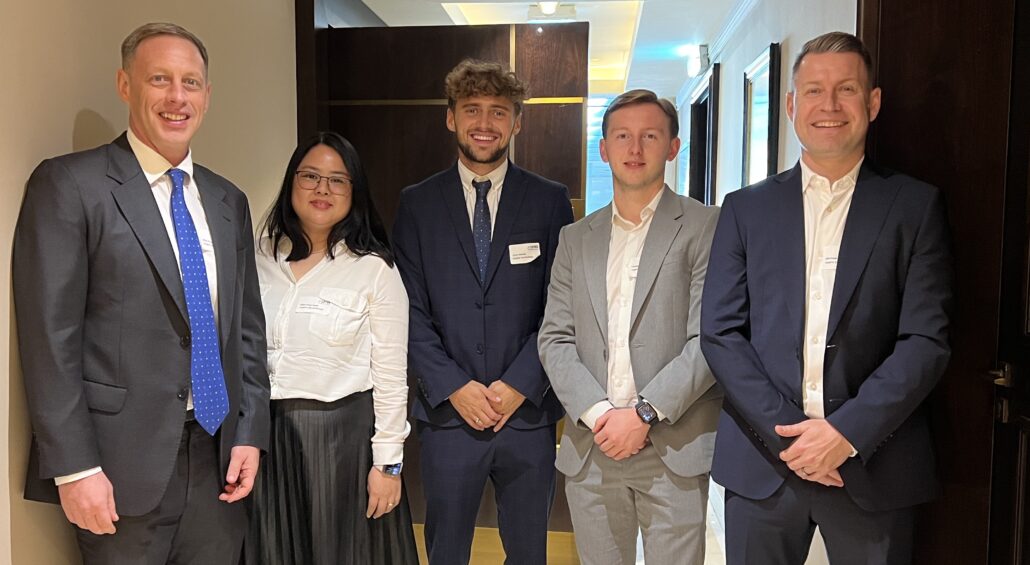
On Wednesday, 4 February 2026, hiring managers and HR leaders from across Dubai gathered to discuss a challenge shaping organisations across the region: how to retain talent and manage employment risk in a market defined by choice and movement.
Through a market update and a legal briefing, attendees were reminded that while the GCC employment landscape is strong, its pace and competitiveness require organisations to think more proactively than ever before.
Market update: A workforce that knows it has options
Opening the event, Nick Drzymalski highlighted a defining shift, 72% of professionals in the GCC are open to changing roles, significantly higher than Western Europe. Importantly, openness does not equal unhappiness. Instead, it reflects growing confidence and optionality within a thriving labour market.
Several structural factors are driving this mobility:
- An expat-heavy workforce motivated by career progression and financial goals
- Rapid business growth expanding roles faster than compensation
- Rising living costs, particularly housing
- Commute times increasing across the city
While salary remains important, it is no longer a guaranteed retention tool. Many employees feel responsibility has outpaced pay, and modest annual increases rarely offset meaningful lifestyle pressures such as higher rent or longer daily travel.
These pressures may not immediately appear in engagement data, but they gradually influence how employees evaluate their roles, lowering the threshold at which they consider new opportunities.
Average tenure is also trending downward, reinforcing the idea that retention is no longer automatic. It is a decision employees revisit regularly.
When asked what matters most, employees still point to familiar priorities:
- Total compensation
- Work-life balance
- Flexible working
- Career progression
- Leadership and culture
What has changed is the frequency of reassessment. Employees are recalculating both financially and emotionally far more often than in the past.
The leadership question emerging for 2026 is simple but powerful:
If employees can leave, why would they choose to stay?
Organisations that succeed are unlikely to be those that simply pay the most. Instead, they will focus on reducing everyday friction, whether through clearer career pathways, stronger leadership, manageable workloads, or greater flexibility, creating workplaces that feel sustainable as well as rewarding.
UAE Employment Law: Preventing hidden liabilities
Mansour Elaraby and Maya Ahmed from HFW, provided a legal update, offering practical guidance on where organisations should focus their risk management efforts.
One key area was gratuity liability linked to international transfers. UAE courts may treat moves between related entities as continuous employment, meaning gratuity could be calculated from the original start date, even if end-of-service benefits were previously paid in another jurisdiction. For long-tenured employees, this can create substantial unexpected costs, making forward provisioning essential.
Another emerging concern is the interaction between the 1988 and 2021 employment laws. In some cases, courts have awarded unpaid leave claims under both frameworks, effectively doubling employer exposure. Many organisations provision only for the statutory limit, leaving them vulnerable should disputes arise.
Contract governance was repeatedly emphasised as a critical safeguard. Changes to core terms such as salary, working hours, or location require mutual agreement and proper documentation. Where multiple agreements exist, courts tend to favour whichever interpretation benefits the employee, reinforcing the importance of consistency and clarity.
Bonus structures also demand careful drafting. While discretionary bonuses remain at the employer’s discretion, performance-based incentives must be handled precisely. Paid leave cannot reduce entitlement, and employees who achieve targets may still be owed bonuses after termination unless contracts explicitly state otherwise.
The overarching message was straightforward: ambiguity creates risk, while clarity provides protection.
Flexibility, remote work, and the shift toward outcomes
Flexible working continues to reshape employment expectations across the region. However, remote arrangements, particularly when employees work outside the UAE, introduce visa, tax, and regulatory considerations that organisations must actively manage.
Encouragingly, many businesses are evolving beyond measuring time spent at a desk toward evaluating productivity and outcomes. Flexibility is increasingly viewed not as a perk, but as part of a modern employment offering.
Globally, developments such as “right to disconnect” legislation signal a broader shift toward employee wellbeing, a trend likely to influence expectations in the GCC over time.
The strategic takeaway for HR Leaders
Together, the sessions painted a clear picture of the employment relationship in 2026: more deliberate, more transparent, and more dynamic on both sides.
Employees are actively choosing where they work, and reassessing those choices often. At the same time, courts are demonstrating strong protection of employee rights, raising the stakes for employers who lack robust contractual frameworks.
For HR leaders, the mandate is twofold:
- Build environments employees genuinely want to remain part of
- Ensure policies and contracts are resilient enough to support growth
Retention is no longer the default outcome of employment, it is a choice employees make year after year.
The organisations that thrive will be those that recognise this shift early and design their people strategies accordingly.